

The Magnetic Pull of National Politics
I understand the impulse completely. You decide you want to get involved in your community, and your mind immediately jumps to the presidential race, congressional seats, or the latest Supreme Court decision dominating your social media feed. The stakes feel enormous, the personalities are compelling, and frankly, national politics offers a kind of entertainment value that your city council meeting simply cannot match. There’s something intoxicating about debating foreign policy or constitutional law with friends over dinner.
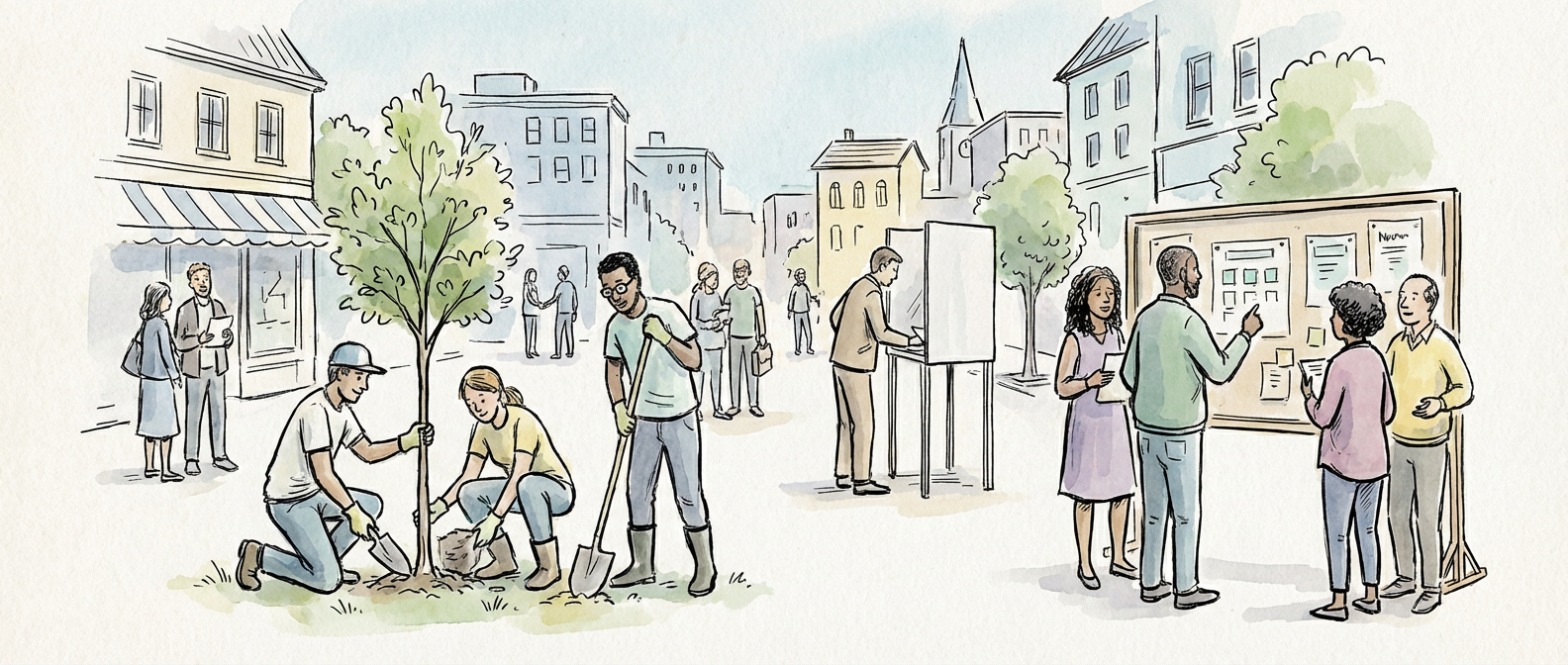
This gravitational pull toward national issues makes complete sense psychologically. Federal politics come with built-in narratives, clear heroes and villains, and the comforting illusion that if we could just fix things at the top, everything else would fall into place. The media ecosystem reinforces this bias, offering wall-to-wall coverage of federal races while your local school board election might get a two-paragraph mention in the community newsletter.
But here’s what I’ve learned after two decades of watching people dive into civic engagement: starting with national politics is like trying to learn piano by jumping straight into a Rachmaninoff concerto. Sure, it’s technically possible. But you’re setting yourself up for frustration, burnout, and the nagging sense that your voice doesn’t matter in a system of hundreds of millions.

The Counter-Intuitive Power of Local Engagement
Local politics operates on a completely different scale of influence, and this is where the magic happens for new civic participants. In my city of 85,000 people, I’ve watched a single persistent resident change the entire approach to bicycle infrastructure by showing up to transportation meetings for six months straight. I’ve seen a neighborhood group of twelve people successfully advocate for a new traffic light that had been “under consideration” for five years. These aren’t anomalies. They’re the natural result of engaging where your individual voice carries actual weight.
The math here is striking. Your vote for president is one among roughly 150 million. Your vote for city council might be one among 3,000. In some local races, I’ve seen margins of victory smaller than the number of people who live on a single city block. When you call your congressional representative, you’re competing with 700,000 other constituents for attention. When you email your city council member, you might be one of a dozen people they hear from that week on any given issue.
More importantly, local government controls the infrastructure of your daily life in ways that federal policy rarely touches directly. The condition of your roads. The frequency of your trash pickup. The safety of your drinking water. The quality of your children’s schools. The zoning decisions that determine whether you’ll have a grocery store or a strip club next door. These decisions happen at planning commission meetings and city council sessions, often with minimal public input because so few people show up.
Building Skills in a Forgiving Environment
Local politics offers something invaluable for civic beginners: a chance to develop democratic participation skills in an environment where mistakes aren’t catastrophic and learning happens in real-time. At your first city council meeting, you can observe the formal procedures, understand how public comment periods work, and get a feel for the personalities and dynamics involved. No pressure of a high-stakes national debate. No cable news cameras.
The research skills you develop investigating local candidates translate directly upward. Learning to read campaign finance reports for a school board race teaches you exactly the same principles you’ll use to evaluate congressional candidates. Understanding how to find voting records for your state representative prepares you to navigate more complex federal databases. The difference is that local races often involve candidates without extensive public records, so you’ll learn to ask better questions, attend candidate forums, and evaluate promises against realistic possibilities.
Perhaps most importantly, local engagement teaches you the rhythm of democratic participation beyond just voting. You learn that democracy is not a spectator sport played out on television every four years, but a continuous process of community input, compromise, and incremental progress. You discover that meaningful change often happens through sustained attention rather than viral moments. Showing up consistently matters more than showing up loudly.
The Ripple Effect of Local Knowledge
Here’s where local engagement becomes a force multiplier for broader civic participation. Once you understand how your city budget works, federal budget debates become more concrete and comprehensible. When you’ve watched your planning commission grapple with balancing economic development against environmental concerns, you bring lived experience to discussions of national environmental policy. Having advocated for better public transportation in your own community gives you a practical framework for evaluating federal infrastructure proposals.
Local engagement also builds your network of civic-minded neighbors, which becomes important when you do want to tackle larger issues. The parent you meet advocating for school crossing guards might become your co-organizer for a congressional candidate campaign. The neighbor who helped you research water quality issues might join you in pressuring your state legislature on environmental regulations. Political movements grow from relationships, and relationships grow from shared local concerns.
The confidence you build successfully advocating for a bike lane or attending budget hearings translates into the courage to call your senator’s office or write letters to newspaper editors. You learn that elected officials are human beings who respond to constituent pressure, not mysterious figures operating in an inaccessible realm. This demystification of the political process is perhaps the greatest gift local engagement offers to civic beginners.
Making the Local Choice
I’m not arguing that national politics don’t matter. They absolutely do, and an engaged citizenry must ultimately pay attention to all levels of government. But for someone taking their first steps into civic life, the local level offers the best combination of accessibility, impact, and skill-building opportunities. You can see results. You can develop expertise. You can build the foundation for a lifetime of effective civic participation.
The beauty of this approach is that it works regardless of your political philosophy. Conservative or progressive, libertarian or socialist, the mechanics of local engagement remain the same: show up, ask questions, build relationships, and advocate for your vision of community improvement. The skills are transferable, the satisfaction is immediate, and the democratic muscles you build locally will help you when you’re ready to tackle bigger challenges.
Start by finding out when your next city council meeting is. Look up who represents you on your school board. Research the candidates in your upcoming local elections. Your democracy needs you to begin where you can make the biggest difference, and that place is closer to home than you might think.