

Posted on March 17, 2026
When Tariffs Remake the World: Understanding Trump’s 2025 Trade Pivot and Its Historical Echoes
The April Announcement: Executive Authority Meets Economic Theory
On April 2, 2025, President Trump signed an executive order that reshaped global trade in ways we’re still measuring. The announcement of reciprocal tariffs was more than a policy shift—it was a direct assertion of executive power over international commerce. The baseline 10% tariff on all imports, climbing to 145% on Chinese goods, came wrapped in the language of economic nationalism and self-sufficiency. What made this moment historically significant wasn’t the tariffs themselves. It was the speed of implementation and the breadth of executive authority claimed to do it.
If you study American tariff history, you recognize the pattern. Presidents from McKinley to Reagan invoked similar language about protecting American workers and industry. But there’s a crucial difference in 2025: the global economy is exponentially more interconnected than it was in those earlier eras. A 145% tariff on Chinese goods in 1890 affected a narrow range of manufactured items. The same tariff in 2025 touches everything from semiconductor components to rare earth minerals in the technology most of us carry in our pockets. That’s not a historical parallel—it’s a historical acceleration.
The Human Cost: What the Numbers Actually Mean
Here’s where the conversation needs to move beyond headlines to household reality. The Peterson Institute tariff impact analysis estimated that the April package would reduce real household income by an average of $2,600 annually. Let that number sit for a moment. That’s not abstract economic theory—that’s grocery bills, prescription copays, and the calculation families make about whether they can afford new shoes for growing children.
What’s instructive about this estimate is what it reveals about trade economics that many voters never encounter in public debate. Tariffs don’t just affect prices on imported goods. They increase costs for American businesses that rely on imported materials. Those increased costs ripple outward through supply chains, eventually landing on consumer prices. A tariff on imported steel makes it more expensive for American manufacturers to build appliances. Those manufacturers pass costs along. You see it at the store. This isn’t ideology—it’s how interconnected supply chains actually work.
The Peterson Institute didn’t arrive at $2,600 through partisan calculation. They modeled the actual flow of goods, the substitution effects, and the efficiency losses. When you read that number in news coverage, you’re reading economic modeling translated into lived experience. That’s the conversion that matters most for citizens trying to understand what trade policy actually means for their families.
Retaliation and the 90-Day Pause: How Allies Responded
The European Union didn’t hesitate. Before May 2025 arrived, the EU announced counter-tariffs on approximately 21 billion euros worth of American goods. That wasn’t reflexive anger—it was calibrated strategy. European policymakers identified American exports that mattered politically within their member states: agricultural products, consumer goods, luxury items. They chose targets designed to create pressure in Congress and state legislatures, knowing that’s where trade policy ultimately gets renegotiated.
It’s worth stepping back and recognizing what this moment represented historically. For decades, the United States was the relatively stable anchor in global trade. American willingness to maintain open markets, to absorb other nations’ exports, to keep the trading system functioning—that was foundational to the post-World War II order. When America pivoted to reciprocal tariffs under unilateral executive authority, trading partners faced a different calculation. They couldn’t assume the old rules applied. The EU’s counter-tariffs were less about punishment and more about signaling: we have leverage too, and we’ll use it if necessary.
The 90-day truce negotiated in May 2025 gave both sides room to maneuver. It allowed the administration to claim victory while negotiations continued. It allowed the EU to demonstrate they weren’t capitulating. But truces are temporary by definition. What happened during those 90 days would determine whether the tariff architecture became the new normal or shifted into something different.
Agricultural Devastation and Government Response
If there’s a single sector that crystallizes the human impact of tariff policy, it’s American agriculture. China’s retaliatory tariffs on U.S. agricultural exports reached 125%, a number that needs translation: it means Chinese importers would pay vastly more for American corn, soybeans, and wheat than they paid before. Predictably, they stopped buying, or dramatically reduced purchases. American farmers who had invested in equipment, land, and operations based on decades of Chinese demand suddenly faced a market that evaporated.
The USDA’s emergency aid commitments exceeded $14 billion in affected farm states. That’s government intervention on a massive scale. That number represents direct payments to farmers, loan forgiveness, crop insurance adjustments—the visible hand of government trying to cushion a shock that tariff policy created. The historical parallel is worth noting: when Smoot-Hawley raised tariffs in 1930, agricultural states initially supported protection for manufacturing but watched their own exports shrivel as trading partners retaliated. Farmers had to be bailed out then too.
The difference now is transparency. We can see the aid commitments in real time. We can track where the money goes. That creates accountability, or should, if citizens engage with the information. It also raises a question that goes beyond partisan politics: when government uses tariff policy to reshape markets, who bears the costs and who receives the support? The answer to that question matters more than the tariff rates themselves.
The Global Reckoning: What the IMF Saw by October
By the time the International Monetary Fund released its World Economic Outlook in October 2025, the broader picture came into focus. The IMF downgraded global GDP growth by 0.8 percentage points, attributing the revision directly to trade fragmentation from the American tariff regime. That’s not a small adjustment. Global GDP is measured in the trillions. A 0.8 percentage point shift affects employment, investment, and development prospects across every economy on earth.
What’s instructive about the IMF’s analysis is that it documents something economists have long understood but policymakers sometimes resist: tariffs create winners and losers, but the aggregate effect is usually negative. Specific industries and workers in those industries might benefit from protection. But consumers, businesses relying on imported materials, and trading partners’ economies all absorb costs. When you model it across an entire global system, the losses outweigh the gains.
This brings us back to that historical parallel. In the 1930s, when nations retreated into protectionist trade policies during the Great Depression, they accelerated economic decline rather than reversing it. The world eventually learned that open trade, whatever its distributional challenges, generated prosperity more effectively than protection. The question facing policymakers in late 2025 was whether that lesson still applied. The answer, it seemed, was yes—but only after billions of dollars in costs had already accumulated.
What Comes Next: Understanding Your Role in Trade Policy
Trade policy sits at the intersection of economics, law, and politics. It’s the kind of issue that affects your life but often feels too technical to engage with meaningfully. That’s exactly why it matters that you try. Congressional representatives vote on trade bills and can influence executive trade policy through legislation. Senate confirmation of trade negotiators and cabinet secretaries affects who shapes these policies. Local business leaders and agricultural leaders testify before Congress about tariff impacts. This policy isn’t made in some distant ivory tower—it’s made by people you can contact, persuade, and hold accountable.
If you want to understand what comes next in American trade policy, start by asking questions. Who benefits from the current tariff structure? Who bears the costs? Are those costs distributed fairly? What did similar policies accomplish historically, and what can we learn from those outcomes? Those questions don’t come with predetermined answers. They’re the genuine civics work of informed citizenship—and that’s where this story matters most, not in the headlines about trade wars, but in your capacity to engage with the actual policy and the actual people making it.
Posted on March 16, 2026
The AI Governance Gap: Why August 2025 Changed Everything for Your Local Economy
When Brussels and Washington Stopped Speaking the Same Language
If you’ve been following tech policy closely, you probably noticed something shift in the political temperature around artificial intelligence sometime between January and August of this year. It wasn’t subtle. The new Trump administration issued an executive order in January that essentially dismantled the Biden-era AI safety framework and took direct aim at the European approach to AI regulation. The language was pretty clear: the EU AI Act wasn’t just different from American policy. It was being framed as a direct threat to American competitiveness. That’s not the kind of thing that gets walked back quietly.
What made this moment matter, though, wasn’t the rhetoric. It was what happened next. When August 2, 2025 arrived and the EU’s high-risk AI system provisions actually went into enforcement, something became real that had previously lived mostly in think tank reports and conference speeches. We weren’t dealing with a theoretical divergence anymore. We had two fundamentally different regulatory systems colliding in real markets, affecting real companies and real consumers on both sides of the Atlantic. The moment when policy disagreement becomes an actual trade problem has a way of focusing everyone’s attention.
Understanding What August 2025 Actually Required
Let me walk you through what the enforcement deadline actually meant, because this is where the rubber hit the road. The EU AI Act’s core prohibitions on the most dangerous AI systems had already kicked in back in February 2025. Those were the systems designed to deliberately manipulate or exploit vulnerable people, or to enable mass surveillance through emotion recognition technology. That part was enforceable right away. But the high-risk category, the real operational machinery of the regulation, that’s what August brought into full force.
High-risk systems include AI used for biometric categorization, decisions about critical infrastructure, employment screening, and creditworthiness assessments. If you’re a mid-sized software company operating in Europe and you’ve built an AI tool for any of these purposes, August 2 meant you couldn’t deploy it without meeting a specific compliance checklist. Documentation requirements. Risk assessments. Human oversight protocols. Transparency obligations to users. None of this is unreasonable on its face. But consider the cost. A Stanford HAI: AI Policy Briefs 2025 analysis from November estimated that compliance for a single high-risk system deployment could run between fifty thousand and three hundred and forty thousand dollars for a mid-sized enterprise. For every system. For every market. That number matters because it changes the math of whether a company even tries to serve European customers.
Why This Creates a Real Trade Problem, Not Just a Regulatory One
Here’s the part that brings this down from the abstract into something that affects how your local economy functions. When you have two major economic zones operating under fundamentally incompatible rules, companies have to make choices. They can try to maintain two separate compliance regimes, expensive and complicated. They can choose to exit one market entirely, which usually means the American company exits Europe. Or they can attempt some kind of hybrid approach that satisfies both, which tends to be the worst of both worlds because you’re not really complying with either framework fully.
The European AI Office took a dramatic step in October 2025. They issued their first formal investigation notice against a major American AI developer for deploying a general-purpose AI model in EU member states that didn’t meet the compliance requirements. This wasn’t a warning letter. This wasn’t a consultation. This was enforcement. It sent a signal that the EU wasn’t going to grandfather in existing systems or allow companies to slowly transition. You either complied by the deadline or you faced consequences. That’s when American companies had to actually do the math on whether Europe was still worth the investment.
The Tripartite World We’re Actually Living In Now
What makes this regulatory split even more complicated is that we’re not looking at a simple transatlantic divide anymore. China published its second iteration of generative AI regulations in mid-2025, and they took a different approach entirely. These regulations require domestic content filtering and impose specific structural requirements on how AI systems operate within Chinese borders. Council on Foreign Relations analysts have started describing what’s emerged as a tripartite global AI regulatory architecture that is, in their words, now firmly established. Europe has one approach. America has essentially opted out of coordinated frameworks. China has its own system. Suddenly companies have to navigate three completely different regulatory environments if they want to operate globally.
This is the moment where the conversation stops being about whether regulations are good or bad and starts being about what happens when global commerce operates under three incompatible rulesets. The European approach emphasizes safety and transparency and is willing to impose compliance costs to achieve it. The American approach, at least under current policy, emphasizes speed and innovation and is skeptical of heavy-handed regulation. The Chinese approach emphasizes state control and domestic preference. These aren’t just different emphases. They’re incompatible directions.
What This Actually Means for Your Community
The reason I’m spending this much time on what might seem like a distant regulatory story is that it affects decisions being made right now in your city or town. Small and mid-sized software companies, the ones that do serious innovation work, are having to make strategic decisions about which markets they can realistically serve. If you’re in a tech hub, your local employment picture gets affected by these decisions. If you’re in a region trying to recruit tech companies, the regulatory environment suddenly matters more. If you work for a company that builds AI tools, you’re now working within a different competitive landscape than you were six months ago.
The costs of compliance also matter for consumer prices and service availability. When compliance costs jump by hundreds of thousands per system deployment, those costs eventually show up somewhere. Either companies absorb them and reduce margins, or they pass them through to customers. Or they decide certain markets aren’t worth serving anymore. All of those outcomes are real trade-offs that affect real people.
There is one genuinely encouraging thing here: none of this is happening behind closed doors. The European AI Office has published implementation guidance. You can actually track what compliance looks like. European AI Office: EU AI Act Implementation Hub makes the requirements available. Congress is having hearings about American AI policy. If you care about how these systems get regulated, and you should care because they’re increasingly embedded in decisions that affect your life, now is actually the moment to engage. Local advocacy organizations are starting to work on these issues. City councils are beginning to grapple with AI policy questions. Participation shapes outcomes here, and those outcomes ripple back into your community in ways big and small.
What questions are you noticing about AI policy in your own area? What decisions are local businesses in your community facing? I’d genuinely like to hear what this looks like from your vantage point.

Posted on March 16, 2026
Sudan at Two Years: When the UN’s Failures Become a Mirror for Its Future
The Scale of Catastrophe We’ve Learned to Ignore
Two years into Sudan’s civil war, we’ve reached a threshold that should terrify anyone who believes in international institutions. On April 15, 2023, fighting erupted between the Sudanese Armed Forces and the Rapid Support Forces, a paramilitary group with deep roots in the Darfur conflict. By early 2025, this war had displaced more than 11 million people within Sudan’s borders. To put that number in perspective: that’s roughly the population of Belgium or Greece, forced from their homes not by natural disaster but by deliberate human choice. According to UNHCR data, this is now the world’s largest internal displacement crisis. The previous holder of that grim title was Syria. We know what Syria taught us about the limits of international concern.
What strikes me most about covering this moment is how familiar the machinery of failure has become. I’ve spent years studying how democratic institutions decay, how checks and balances erode when people stop insisting they matter. The international response to Sudan feels like watching that same process unfold at a global scale, just faster and with higher stakes. There’s a particular sadness in recognizing the pattern.

The Funding Gap as Political Statement
Let’s talk about money, because money is where political commitment reveals itself most clearly. The UN Office for the Coordination of Humanitarian Affairs developed a 2024 response plan for Sudan’s humanitarian emergency. They identified what they needed: $2.7 billion. What arrived? $1.4 billion. That 48% funding gap isn’t a bureaucratic inconvenience. It’s a body count waiting to happen. When you can’t purchase food, medicine, and water purification systems, people starve. People die of preventable disease. Children never learn to read.
I’ve worked with community organizations that faced similar shortfalls. I’ve watched them make impossible choices about who gets served and who doesn’t. The difference is that a local food bank serves a city. The UN’s Sudan operations serve tens of millions. The moral weight is almost incomprehensible. What’s particularly striking about this specific failure is that it wasn’t an act of God or an economic impossibility. Wealthy nations chose not to fully fund the response. They made a calculation that Sudan mattered less than other demands on their budgets. You can check the UN OCHA Sudan Humanitarian Response Plan documents yourself and see exactly what assistance was planned and what fell away.
The Security Council’s Theater of Paralysis
Here’s where the institutional failure becomes almost Shakespearean. The UN Security Council exists, in theory, to coordinate responses to threats to international peace and security. Sudan qualified. A binding ceasefire resolution should have been a basic function of that body in 2024. Instead, the Security Council failed to pass one. Russia and China vetoed or abstained on substantive action. These aren’t mysterious decisions. Both nations have strategic interests in Sudan and a permanent seat at the table. The system designed to prevent great powers from blocking humanitarian action became the weapon that enabled them to.
This echoes the deadlock on Syria, which in turn echoes the paralysis on Rwanda before it. Historical parallels have limits, I know that. The contexts differ. The players have different relationships to the conflicts. But the pattern is real: permanent Security Council members use their veto power to protect allies or advance geopolitical interests, and civilians pay the price. The question isn’t whether this will happen again. It’s whether we’ll finally acknowledge that a system this broken needs fundamental reform.
Famine and the Collapse of Prevention
In August 2024, the Integrated Food Security Phase Classification made a formal declaration. Famine conditions existed in the Zamzam displacement camp in North Darfur. This was the first famine declaration anywhere on Earth since Somalia in 2022. Think about what that means: we have systems designed to prevent famine. We have early warning indicators. We have humanitarian organizations positioned to respond. And yet famine happened anyway. That’s not a failure of knowledge or capability. That’s a failure of will.
The Zamzam camp housed some of Sudan’s most vulnerable people. They were already displaced. They were already dependent on external aid. The conditions that produced famine didn’t materialize overnight. They accumulated, week by week, as funding failed to arrive and political will evaporated. Visit UNHCR Sudan Emergency Situation Updates and you’ll see the historical timeline. The warning signs were visible. What was missing was the response.
Justice Without Enforcement: The ICC’s Hollow Victory
In 2024, the International Criminal Court issued an arrest warrant related to atrocities committed by forces linked to the Sudanese Armed Forces in Darfur. This should have been significant. The ICC exists to prosecute crimes against humanity, war crimes, and genocide. An arrest warrant is precisely what that institution is designed to produce. But here’s the catch that makes you understand why reform advocates are so urgent about these institutions: the ICC has no police force. It has no army. It depends on member states to arrest suspects and turn them over. Sudan hasn’t complied. The international community hasn’t forced the issue. The warrant sits like a beautiful principle with no power behind it.
It reminds me of something a mentor once told me about local government: a policy that can’t be enforced isn’t a policy, it’s a suggestion. The same applies here, just at a continental scale. The ICC did its job. The international system failed to back it up.
What Reform Actually Looks Like
So what does this mean for the future of UN reform? The Sudan crisis has become a test case because it’s so clearly a moment where the system failed not by accident but by design. The Security Council’s structure gives veto power to five nations. That structure creates paralysis. The funding mechanisms for humanitarian response depend on voluntary contributions. That creates underfunding. The enforcement mechanisms for international law depend on state cooperation. That creates impunity. These aren’t bugs. They’re features of a system built in 1945 to reflect a different world.
Real reform would require permanent Security Council members to accept constraints on their power. It would require wealthy nations to fund humanitarian response as a binding obligation rather than a discretionary choice. It would require enforcement mechanisms that don’t depend on the good faith of governments. These changes won’t happen because powerful actors benefit from the current system. But understanding why they should happen, and articulating that clearly, is where movements for change begin.
Sudan’s civil war will eventually end. The immediate humanitarian crisis will eventually improve or, worse, fade from international attention. But the institutional questions it has exposed will remain until we confront them directly. If you’re interested in digging deeper into how these systems work and what meaningful reform would require, research specific UN reform proposals. Look at what different advocacy organizations are proposing. Talk to people working in humanitarian response about what structural changes they think would actually matter. This is the kind of issue where informed public opinion can shift what feels politically possible. It happened with decolonization. It happened with human rights. It can happen again if enough people decide that institutions matter enough to fight for their improvement.
Posted on March 14, 2026
The February 2025 German Election: When Structural Shifts Reshape an Entire Continent
Understanding What Happened in Germany’s Snap Election
Germany held a snap federal election in February 2025, and the results say something important about where European politics actually stands right now. The Christian Democrats and their Bavarian sister party, the CSU, took approximately 28.6 percent of the vote, giving them the largest share and the mandate to form the next government. Friedrich Merz, the CDU/CSU leader, would become Chancellor. But the single headline misses the bigger picture: the structural forces that produced these numbers are reshaping how Europe functions.
To get the real story, you need to look at the whole electoral landscape. The Alternative for Germany, or AfD, finished second with roughly 20.8 percent of the vote. That’s the strongest result for a far-right party in post-war German federal history. Meanwhile, Chancellor Olaf Scholz’s Social Democrats fell to around 16.4 percent, their worst federal election result since 1933. These aren’t random fluctuations. They reflect genuine realignments in how German voters relate to their political institutions.
The Economic Constraints That Shaped Political Outcomes
To understand why these shifts happened, you need to understand Germany’s constitutional framework. The country operates under a strict “debt brake” provision limiting new government borrowing to just 0.35 percent of GDP. Think of it as a constitutional handcuff on fiscal policy. When Scholz’s government faced economic headwinds, rising energy costs, and manufacturing challenges, their ability to respond with stimulus spending was severely constrained. Voters could see the problems, see limited solutions, and began looking elsewhere.
The new CDU/CSU-led government inherited this same constraint. The coalition faces immediate pressure to increase public investment, support Ukraine, strengthen NATO capabilities, and address economic stagnation. A new Chancellor doesn’t make the debt brake disappear. It remains a structural feature of German politics that any government must work around. This creates a real tension between what voters want their government to do and what the constitutional framework actually permits, and that tension explains much of the political turbulence we’re seeing across Europe.
Defense Spending and the NATO Realignment
This is where the German election becomes a continental story. Chancellor Merz committed to pushing Germany’s defense spending past NATO’s two percent GDP target, with discussions pointing toward three percent. This isn’t an academic policy shift. It’s a fundamental reorientation of German foreign policy and European strategic capacity. You can find NATO’s defense spending framework explained through NATO Defense Spending Targets Explained, but the practical meaning is simple: Germany is preparing to spend tens of billions of additional euros annually on military capabilities.
This shift comes from Russian aggression in Ukraine and a growing recognition that European nations can’t indefinitely rely on American security guarantees without demonstrating real commitment to their own defense. Germany’s move matters more than most countries’ commitments because Germany has the largest economy in Europe. When Germany commits to three percent defense spending, European security architecture changes with it. This is a structural reallocation of resources that will shape European politics for decades, not a symbolic gesture.
The Far-Right Performance and European Democracy
The AfD’s 20.8 percent result deserves serious attention because it reveals something about contemporary European politics that goes well beyond Germany. One of Europe’s most historically conscious societies, a nation that spent seventy years building democratic institutions specifically designed to prevent extremism, still cast one-fifth of its ballots for a far-right party. That’s not about individual politicians or campaign messaging. It reflects voter anxiety about migration, economic security, and rapid social change, and that anxiety appears across wealthy democracies right now.
What’s worth noting is Germany’s response. Rather than panic, German political institutions held. The CDU/CSU formed a coalition without the AfD. Other parties maintained constitutional guardrails. This matters because it shows that structural institutions can still function as designed, even under real pressure. The results are sobering, but they also confirm that Germany’s post-war constitutional order remains durable. That said, durability isn’t the same as stability. The AfD’s strength reflects genuine political forces that won’t disappear simply because democratic institutions excluded them from government.
What This Means for Europe’s Future
The February 2025 German election clarified structural realities that were already present but not fully visible. Germany’s coalition government will operate under constitutional constraints that limit spending even as defense requirements increase. European security architecture will shift toward greater German military capacity and reduced reliance on American guarantees. Political movements critical of immigration and rapid social change have proven they command one-fifth of the German electorate, with similar movements strengthening across Europe. These aren’t problems that elections solve. They’re structural features that governments must manage.
If you want to understand where European politics heads next, don’t focus on individual politicians or campaign slogans. Look at the structural forces: aging demographics, fiscal constraints, security threats, and rapid technological change. Look at how German institutions responded to electoral pressure without abandoning constitutional principles. Look at the economic limits that constrain even the most powerful European government. Then apply that lens to your own country’s political situation. You’ll likely find similar forces shaping your local politics in ways that transcend individual leaders or parties.
For detailed election results, the German Federal Returning Officer Official Results are worth reviewing. But numbers alone don’t tell the story. The story lies in understanding the structural constraints that produced those numbers, and recognizing that German voters, like voters everywhere, respond rationally to the possibilities and limitations they perceive. What does this raise for you about your own political system? How are structural forces shaping your local elections?
Posted on March 14, 2026
Germany’s February 2025 Election: What Merz’s Narrow Coalition Math Means for Europe
The Numbers Tell a Story of Fragmentation and Constraint
Let’s start where all serious election analysis must begin: the actual results. On February 23, 2025, German voters delivered what looked like a clear verdict and what turned out to be a complicated puzzle. The CDU/CSU alliance secured roughly 28.5% of the vote, its strongest performance since 2017. This was real. This was substantial. And yet, if you understand how German coalition mathematics work, you immediately recognize that 28.5% is not a mandate to govern alone.
Here is what makes German politics different from what many English-speaking observers expect: you do not need a majority of the vote to form a government. You need a majority of seats in the Bundestag. The CDU/CSU’s 28.5% translated into enough seats to make them kingmakers, but not kings. The real story is in what happened around them.
The Federal Returning Officer official 2025 Bundestag results show that the AfD, the right-wing populist Alternative for Germany party, finished second with approximately 20.8% of the vote. Their best federal election performance ever. Let that sink in. This was not a freak result. This was the culmination of a trend accelerating for years. The traditional center collapsed further. The SPD, governed by outgoing Chancellor Olaf Scholz, fell to around 16.4%. That is the worst result for the Social Democrats in a federal election since World War II. The era of predictable two-party dominance in Germany is definitively over.
The Slim Margin and Why It Matters
Friedrich Merz did not walk into the chancellery with a comfortable cushion. When the dust settled and coalition talks concluded, Merz was confirmed as Chancellor in April 2025, leading a grand coalition between the CDU/CSU and the SPD. Germany’s third such “GroKo” since 2005, which matters more than it might initially appear.
Grand coalitions in Germany work like this: the two largest parties across the left-right spectrum agree to govern together, splitting ministerial portfolios and policy priorities. The math favors stability. The politics often produces gridlock. When your coalition partner controls enough seats that you cannot govern without them, every negotiation becomes zero-sum. Every budget line item, every legislative priority, every appointment becomes a bargaining chip.
But there is a threshold question that haunts every narrow coalition in parliamentary systems: what happens when one partner faces electoral pressure to differentiate itself from the other? The SPD’s historic collapse to 16.4% means they are not entering this coalition from a position of strength. They are entering from desperation. They need to demonstrate that they can still deliver something their voters care about, or face further erosion. The CDU/CSU, meanwhile, is trying to avoid the appearance of governing for the wealthy and the established while a popular right-wing party captures nearly a quarter of the electorate.
The Debt Brake Debate and Europe’s Economic Stability
Germany faces a structural deficit estimated at over €100 billion. This is not a small accounting adjustment. This is a fundamental gap between what the government commits to spend and what it collects in revenue. The conversation around how to address this deficit dominated early coalition talks and will continue to define what this government can and cannot do.
The Schuldenbremse, commonly translated as the debt brake, is Germany’s constitutional limit on government borrowing. It allows federal borrowing of only 0.35% of GDP in normal economic times. Reforming or suspending it would require a two-thirds majority in the Bundestag. That is possible with a grand coalition holding roughly 52% of seats, but it requires discipline and political will that are both currently in short supply.
Why does this matter beyond Germany’s borders? Germany is the economic engine of Europe. German fiscal policy choices ripple across the continent. If Merz’s government cannot figure out how to close that €100 billion gap through spending cuts, tax increases, or debt brake reform, it will constrain Germany’s ability to invest in infrastructure, defense, and the transition to renewable energy. At a moment when Europe faces threats from Russia and structural challenges from Chinese competition, a fiscally paralyzed Germany is a problem for everyone.
Coalitions Under Pressure: What the AfD’s Rise Means for Governance
Every member of Germany’s mainstream political establishment faces one hard reality: the AfD came in second with 20.8% of the vote and will sit in the Bundestag as a significant parliamentary force. They are excluded from coalition negotiations by explicit agreement among all other parties. No coalition partner will work with them. But exclusion is not the same as powerlessness.
A narrow CDU/CSU-SPD coalition must govern knowing that if they lose more than a handful of members to defection, they lose their majority. This creates perverse incentives. Controversial votes become harder to call. Grandstanding becomes more tempting because each party needs to show its base that it is fighting for them against the other coalition partner. Discipline and internal party management become critical to survival.
The rise of the AfD also creates a psychological pressure that should not be underestimated. When a major party captures one-fifth of the electorate, it signals that large segments of the population feel unrepresented by existing options. Some of this reflects legitimate grievances. Some reflects xenophobia and nostalgia. Most likely it is both, mixed together in ways that are hard to untangle. A coalition government locked in continuous internal negotiation is poorly positioned to address the root causes of that alienation. It can only respond to the symptoms, and often poorly.
What Narrow Coalition Governance Actually Means in Practice
Here is what coalition mathematics look like when translated into daily governance. Every policy initiative requires negotiation. Cabinet meetings become more like treaty talks between sovereign governments than internal party deliberations. Legislation moves slowly because both coalition partners must sign off. Compromise often means the lowest common denominator rather than the best available option.
The CDU/CSU secured 28.5% and the SPD 16.4%. Together they control roughly 52% of the Bundestag. A working majority, yes. But not a comfortable one. A few defections, a few absences, a few moments of parliamentary drama and the entire coalition is suddenly fragile. This concentrates power in the hands of party discipline and senior negotiators, while backbench voices from smaller delegations can punch above their weight.
For European observers watching from Paris, Brussels, or Warsaw, this matters because it affects Germany’s ability to commit to collective European decisions. A narrowly constructed coalition takes longer to make decisions. It is more reactive than proactive, more focused on managing internal dynamics than on long-term strategic thinking. That is not a moral failing. It is a structural reality of narrow coalition mathematics.
The Path Forward and Your Role as an Engaged Citizen
Friedrich Merz governs Germany with a coalition that will require constant management and renegotiation. The 28.5% for the CDU/CSU was real. The 20.8% for the AfD was real. The SPD’s historic collapse to 16.4% was real. These are not matters of opinion or interpretation. These are facts recorded by the Federal Returning Officer and available for anyone to examine.
What happens next depends on how well this coalition manages its internal contradictions while addressing real problems. Can Merz reform the debt brake without blowing up the coalition? Can the CDU/CSU and SPD find common ground on energy policy, wages, and defense spending? Can they do any of this while the AfD sits in parliament capturing headlines and drawing voters who feel left behind?
These questions matter not just for Germans but for all Europeans. If you care about how your own government relates to Europe, if you want to understand why European unity is harder than it looks, German coalition politics offers a window into the machinery. Dig into these questions. Look at the actual election results. Follow the Bundestag proceedings. Think about what narrow coalitions mean for decision-making.
Posted on March 14, 2026
When States Push Back: How 11 Governors Challenged Federal Immigration Enforcement in 2025
The Executive Orders That Started It All
In January 2025, the federal government issued a series of executive orders that fundamentally expanded interior immigration enforcement authority. These weren’t announcements about border policy or visa processing. They were directives aimed at amplifying ICE operations in the nation’s cities, suburbs, and rural communities. What happened next tells us something important about how American federalism actually works when the stakes feel highest.
At least 11 governors responded by issuing their own executive directives. The list included leaders from California, Illinois, Colorado, and New York, but also governors from states you might not immediately associate with sanctuary policies. These weren’t symbolic gestures. These were legal instruments that restricted how state law enforcement officers could cooperate with federal immigration agents. Some limited facility access. Others prohibited state resources from supporting ICE operations. A few did both. The speed and breadth of this response caught many observers off guard, not because governors hadn’t resisted federal policy before, but because the coalition cut across regional and ideological lines in unexpected ways.
The Legal Collision: Courts, Preemption, and the Preliminary Injunction
When states and the federal government disagree about who has authority over what, courts eventually get involved. By mid-2025, the Department of Justice had filed federal preemption lawsuits against four states, arguing that state restrictions on immigration enforcement violated the Supremacy Clause and interfered with exclusive federal immigration powers. This is where things get technically dense, but it matters. Preemption doctrine is the legal framework courts use to decide whether federal law can override state law. It’s not abstract. It determines whether your state can actually enforce the policies its leaders have adopted.
In July 2025, a federal judge in the U.S. District Court for the Northern District of Illinois issued a preliminary injunction that blocked portions of the federal enforcement directive. Preliminary injunctions are emergency stops. They’re issued when a judge believes the plaintiff has a strong enough legal case to justify halting a policy while litigation continues. The ruling didn’t resolve the underlying constitutional questions, but it did prevent full implementation of federal enforcement measures while the courts worked through the competing claims. These legal battles are still unfolding, and their outcomes will shape federalism doctrine for years.
The Enforcement Numbers: What Actually Happened on the Ground
Here’s where we need to separate the political debate from what the data shows us. The Department of Homeland Security released its Fiscal Year 2025 enforcement statistics in November 2025. ICE conducted over 185,000 interior arrests during that fiscal year. That’s the highest annual total since 2011. Even with state restrictions on cooperation, even with the preliminary injunction, the raw enforcement numbers increased significantly compared to recent years.
This tells us something crucial: state sanctuary policies, as they exist today, do not eliminate federal immigration enforcement. They constrain it. They make it more difficult by reducing the cooperation between state and federal agents. They may redirect ICE resources toward different strategies. But the aggregate data shows that federal enforcement capacity has remained substantial. This is exactly the kind of empirical fact that should shape how we talk about what these state policies actually accomplish and what they don’t. Both supporters and critics of sanctuary policies sometimes make claims that outrun the evidence.
The Legislative Landscape: 47 Bills and 14 New Laws
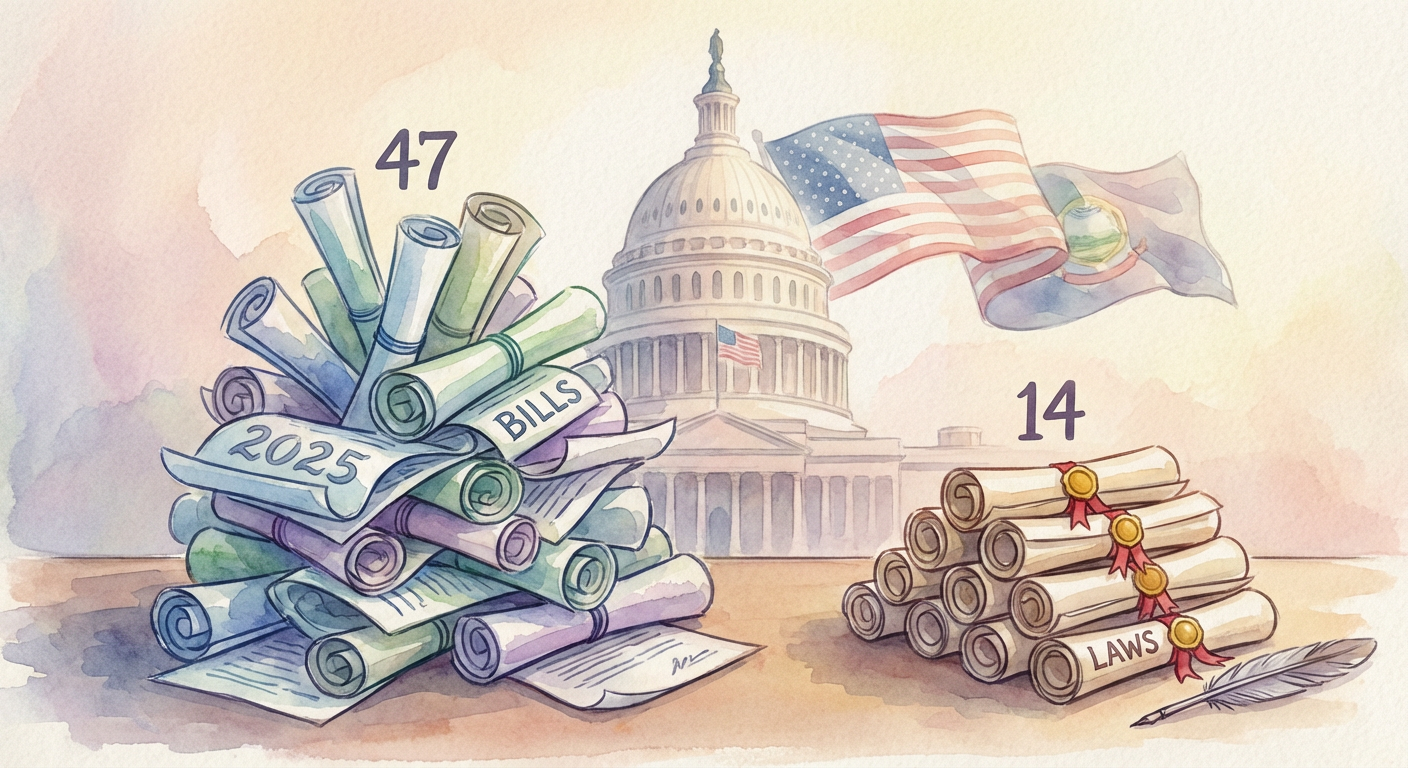
Executive orders grab headlines, but legislatures were the real engine of policy innovation in 2025. The National Conference of State Legislatures tracked 47 state-level bills introduced specifically to address state and local enforcement of federal immigration priorities. These bills ranged from restrictions on cooperation to affirmative duties to assist federal authorities. The diversity of approaches is worth noting. Some states moved toward stricter sanctuary protections. Others moved in the opposite direction. Fourteen of these bills were signed into law.
You can track this legislative work yourself through the National Conference of State Legislatures: Immigration Policy Database, which maintains detailed information about state-level immigration policy. What struck many observers was how granular these bills became. They specified which facilities ICE could access. They defined when officers could request cooperation. They created liability protections for some actors and not others. This is legislating at its most specific, which usually means the political battle is intense and the stakes feel real to constituents.
The Evidence on Public Safety: What the Research Actually Shows
One of the most durable claims in this debate is that sanctuary policies endanger public safety by shielding dangerous individuals from federal authorities. In September 2025, the Stanford Immigration Policy Lab Research team completed a comprehensive study examining violent crime rates in counties with sanctuary policies compared to counties without them. Their finding: no statistically significant difference. Counties with sanctuary policies did not experience higher violent crime rates than non-sanctuary counties.
This doesn’t mean the debate is settled. Research never settles political debates entirely. But it does mean that one of the central empirical claims underlying the debate now has strong evidence against it. Both sides in this argument deserve to reckon with that finding. If sanctuary policies don’t increase violent crime, then the policy case for opposing them rests on different grounds, maybe efficiency arguments or federalism principles or immigration law priorities. Those are legitimate arguments. But they’re different arguments, and they deserve clearer articulation now that the public safety claim has been tested against evidence.
What This Moment Teaches Us About American Federalism
The events of 2025 are a reminder that the federal system isn’t a clean hierarchy. It’s a network of overlapping authorities where governors can actually constrain federal action, courts can block executive directives, and legislators from both parties can force reckonings with evidence. None of these actors has total power. All of them have some leverage.
Understanding how your state responded matters. It matters not because one side is obviously right, but because you live in a state that actually has choices about how it engages with federal policy. That might sound obvious, but it’s worth saying plainly: your state government isn’t powerless. Its choices create real effects. If you want to understand what’s actually happening in your community, look at what your governor issued, what your legislature debated, what courts in your district ruled on. That’s where the civic action is real and your voice can matter.

Posted on March 13, 2026
DOGE at Six Months: Parsing the Real Numbers Behind America’s Most Contested Bureaucratic Experiment
The Gap Between Claims and Verified Results
Six months into the Department of Government Efficiency experiment, we have a genuinely interesting case study in how systemic claims get tested against institutional reality. The administration’s DOGE initiative, led by Elon Musk as a senior advisory body working within the executive branch, announced identification of over $150 billion in potential federal spending cuts by mid-2025. That’s a headline number designed to capture attention, and it did. But when independent auditors actually scored the verified savings from implemented DOGE actions, the Congressional Budget Office placed the realized figure at approximately $27 billion. That’s less than one-fifth of the headline claim, and it matters enormously for how we understand both the program’s actual impact and the broader conversation about federal spending.
This gap isn’t unusual in government reform efforts, but it deserves close attention because it’s so instructive about how bureaucratic systems actually work. The difference between identified potential cuts and realized savings tells us something important: federal spending doesn’t exist in isolation. It’s embedded in legal structures, statutory mandates, contractual obligations, and institutional procedures that don’t simply evaporate when someone identifies them as wasteful. Understanding this distinction is foundational to any serious conversation about government efficiency. The Congressional Budget Office: Analysis of Executive Branch Spending Reduction Actions provides the most detailed accounting we have of what actually materialized versus what was proposed.

Employment Numbers and the Human System Behind Them
The Federal Office of Personnel Management reported that civilian federal employment fell by roughly 75,000 positions in the first half of 2025, through a combination of voluntary buyouts, Reductions in Force (RIFs), and resignations. On the surface, this looks like a straightforward efficiency measure. Fewer employees, lower payroll costs. But what actually happened here is worth thinking through carefully.
When you reduce an organization’s workforce by 75,000 people across the entire federal government, you’re not simply cutting waste. You’re affecting specific offices, specific missions, and specific communities that depend on federal services. Some agencies shed positions from administrative overhead. Others lost personnel from frontline operations. The reduction wasn’t uniform, and that matters. A structural analysis requires asking not just whether these reductions were fiscally efficient, but whether they were allocated according to actual mission criticality or according to political pressure, external mandates, or organizational capacity. When entire field offices close because of RIFs, the question isn’t just how much money was saved. It’s what work stopped getting done and who felt that impact first.
The Legal Architecture Fighting Back
This is where the complexity becomes unmistakable. Federal employee unions filed over 200 legal challenges against DOGE-related directives by mid-2025. The Merit Systems Protection Board faced a backlog of roughly 40,000 pending cases by year’s end. These aren’t just bureaucratic delays. They’re evidence of a legal system pushing back against executive action because that legal system exists for a reason. Federal employment law contains protections for due process, transparent decision-making, and procedural fairness built up over decades. Those protections don’t disappear when a new administration decides to reorganize.
A Brookings Institution analysis published in August 2025 examined precisely this problem: Brookings Institution: Evaluating DOGE’s Legal and Fiscal Foundations found that approximately 60% of the agencies most heavily targeted by DOGE cuts carried statutory mandates that made the proposed reductions legally contestable. That’s the structural issue that matters most. You can’t simply reduce the staffing of agencies whose authority comes directly from Congress without running into serious legal questions about whether you’re still fulfilling statutory obligations. These agencies exist because Congress decided they should. That matters legally, institutionally, and practically.
What We’re Actually Learning About Government
The first six months of DOGE reveal something worth sitting with: the federal government’s structure isn’t arbitrary bureaucratic bloat. It’s a complex system of checks, legal requirements, and institutional constraints that exist because previous generations decided those protections and mandates were important. You might think particular mandates are outdated. You might be right. But dismantling them through executive action, without engaging with the legal and institutional frameworks that created them, produces exactly what we’re seeing: a collision between executive will and structural resistance.
This isn’t an argument for maintaining the status quo. It’s an argument for understanding what we’re actually trying to reform. If government is inefficient, the inefficiency often isn’t where it first appears. It’s not necessarily in the number of employees or the size of agency budgets. More often it lives in processes, systems, legal authorities, or outdated mandates that create friction and waste without anyone intending them to. That kind of inefficiency requires a different approach than workforce reduction or top-line budget cuts.
Thinking Structurally About What Comes Next
The DOGE experiment at six months offers a rare opportunity to study government reform in real time. The structural analysis points to a few conclusions worth considering. First, the gap between proposed cuts and realized savings indicates that federal spending is defended not just by inertia but by legal structures and institutional commitments that require either changing law or working through established processes. Second, indiscriminate workforce reductions risk damaging actual government functions rather than just eliminating waste. Third, legal and regulatory frameworks aren’t obstacles to bypass. They’re part of what we need to understand if we want reform that actually improves government performance rather than just shifting its problems around.
If you’re interested in how government actually works, this moment is worth studying closely. Look at which agencies faced the heaviest cuts and ask what their statutory mandates require. Look at the legal challenges being filed and read what the actual arguments are. Track which services changed for constituents in your area and think about why. These questions matter because they’re how we develop actual democratic literacy about how institutions function. Government reform isn’t technical problem-solving divorced from values and law. It’s a fundamentally political question about what we collectively think government should do, how it should do it, and what protections we want built into those processes. How are you thinking about these questions in your own community and why?

Posted on March 13, 2026
Mexico Under Sheinbaum: Democracy, Cartels, and the Limits of Institutional Power
The Paradox of Revolutionary Consolidation
When Claudia Sheinbaum took office on October 1, 2024, she inherited something that looked like power but functioned as a complex structural challenge. Mexico’s first female president arrived with MORENA, her political movement, controlling supermajorities in Congress. On paper, this represented a democratic mandate. In practice, it created an unusual institutional problem: what happens when one political coalition has so much formal authority that traditional checks and balances become almost theoretical?
Within months, we saw the answer in the judicial reform of early 2025. MORENA’s congressional supermajorities enacted sweeping changes to Mexico’s federal courts, fundamentally altering how judges would be selected. This wasn’t incremental policy adjustment. It was structural reconstruction. The U.S. State Department formally criticized the reform as undermining rule of law, a diplomatic move that signals not just disagreement but concern about institutional degradation. What makes this particularly striking is that we’re not debating whether the reform was good policy. We’re watching the mechanisms of institutional constraint simply disappear.
When Institutions Hollow Out
The judicial reform produced a remarkable statistic: 65 percent of sitting justices on Mexico’s Supreme Court of Justice of the Nation either resigned or declined to participate in the retention election the reform mandated. That’s not a policy disagreement. That’s institutional collapse. When judges refuse en masse to participate in their own governance structure, you’re watching something fundamental break.
This matters beyond court aesthetics. Judges are supposed to function as institutional friction. They’re meant to slow things down, create space for deliberation, and check executive power regardless of which party holds the presidency. Lose that friction and you lose something essential about how democratic systems actually work. Sheinbaum didn’t create this problem singlehandedly. She inherited institutional dynamics that had been building for years. But the structure she now manages is genuinely weaker than what her predecessors faced, even if they had fewer formal allies in Congress.
Cartel Sovereignty and the Limits of State Power
Here’s where structural analysis gets genuinely complicated. While Sheinbaum consolidates formal political power, actual territorial authority remains diffuse and contested. In February 2025, the Trump administration designated six Mexican cartels, including the Sinaloa Cartel and CJNG, as Foreign Terrorist Organizations. This designation carries real consequences. It changes how financial transactions get tracked, alters U.S. military engagement thresholds, and signals that Washington now views this not as a drug trafficking problem but as an organized terrorism problem.
The fentanyl numbers tell part of the story. According to U.S. Customs and Border Protection data, seizures at the U.S.-Mexico border reached 27,000 pounds in fiscal year 2025. That’s an enormous quantity. The fact that U.S. overdose deaths declined for the second consecutive year per CDC preliminary estimates suggests something about U.S. demand, supply disruption, or both. But the structural reality is harder to parse: massive quantities of fentanyl are still reaching American streets, Mexican authorities continue arresting major traffickers, and yet the flow persists. This isn’t a simple resource problem that more funding solves. It’s a structural mismatch between the state’s formal authority and its actual capacity to control territory.
The Cost of Political Violence in Divided Authority
One of the clearest indicators of structural state weakness is local official assassination. The Wilson Center Mexico Institute Political Violence Tracker documented 47 sitting or recently elected local officials murdered between January and October 2025. That’s the highest rate in their tracking period. Let that land: elected officials are being systematically eliminated faster than any previous year they’ve measured.
This reveals something important about what Sheinbaum actually controls and what she doesn’t. She can pass laws in Mexico City. She can direct federal resources. She can coordinate with state governors and municipal presidents who belong to MORENA. But when cartels decide that a particular mayor is insufficiently cooperative, or when rival criminal organizations target local officials to create power vacuums they can exploit, the federal government’s formal authority starts looking pretty thin. Sheinbaum is managing a state where political authority exists at multiple levels simultaneously, and not all of those levels respond to her direction.
Navigating Three Pressures at Once
The genuine complexity of Sheinbaum’s structural position becomes clear when you consider what she’s managing in parallel. First, she’s consolidating institutional control domestically through MORENA’s supermajorities, which creates long-term political advantages but also centralizes risk if those institutions weaken. Second, she’s responding to Trump administration pressure on drug trafficking through foreign terrorist designations and military rhetoric that makes Mexican sovereignty claims more complicated. Third, she’s attempting to govern territories where cartels exercise actual authority over daily life, meaning her formal power doesn’t consistently translate into implemented policy.
None of this is personal to Sheinbaum. A different president would face nearly identical structural constraints, though they might navigate them differently. The question isn’t whether she’s doing a good job in some abstract sense. The question is whether any single executive can actually resolve conflicts between weakened institutions, persistent cartel authority, and external pressure from a more interventionist U.S. administration. Structurally, the answer appears to be no. These are not problems that presidential skill alone can solve.
As you follow Mexican politics over the coming months, watch for specific indicators. Track whether judges continue to function independently or whether they become appendages of the executive. Monitor seizure data at U.S. Customs and Border Protection Fentanyl Seizure Statistics not as a measure of success or failure, but as a window into whether cartel operations are actually being disrupted. Count local official assassinations as a structural measure of where state authority actually exists. These metrics won’t tell you whether Sheinbaum is a good president. But they will tell you something more important: whether the Mexican state is actually reconsolidating control or whether these are just the surface patterns of deeper institutional fragmentation. That’s the real story worth understanding.