

The Executive Orders That Started It All
In January 2025, the federal government issued a series of executive orders that fundamentally expanded interior immigration enforcement authority. These weren’t announcements about border policy or visa processing. They were directives aimed at amplifying ICE operations in the nation’s cities, suburbs, and rural communities. What happened next tells us something important about how American federalism actually works when the stakes feel highest.
At least 11 governors responded by issuing their own executive directives. The list included leaders from California, Illinois, Colorado, and New York, but also governors from states you might not immediately associate with sanctuary policies. These weren’t symbolic gestures. These were legal instruments that restricted how state law enforcement officers could cooperate with federal immigration agents. Some limited facility access. Others prohibited state resources from supporting ICE operations. A few did both. The speed and breadth of this response caught many observers off guard, not because governors hadn’t resisted federal policy before, but because the coalition cut across regional and ideological lines in unexpected ways.
The Legal Collision: Courts, Preemption, and the Preliminary Injunction
When states and the federal government disagree about who has authority over what, courts eventually get involved. By mid-2025, the Department of Justice had filed federal preemption lawsuits against four states, arguing that state restrictions on immigration enforcement violated the Supremacy Clause and interfered with exclusive federal immigration powers. This is where things get technically dense, but it matters. Preemption doctrine is the legal framework courts use to decide whether federal law can override state law. It’s not abstract. It determines whether your state can actually enforce the policies its leaders have adopted.
In July 2025, a federal judge in the U.S. District Court for the Northern District of Illinois issued a preliminary injunction that blocked portions of the federal enforcement directive. Preliminary injunctions are emergency stops. They’re issued when a judge believes the plaintiff has a strong enough legal case to justify halting a policy while litigation continues. The ruling didn’t resolve the underlying constitutional questions, but it did prevent full implementation of federal enforcement measures while the courts worked through the competing claims. These legal battles are still unfolding, and their outcomes will shape federalism doctrine for years.
The Enforcement Numbers: What Actually Happened on the Ground
Here’s where we need to separate the political debate from what the data shows us. The Department of Homeland Security released its Fiscal Year 2025 enforcement statistics in November 2025. ICE conducted over 185,000 interior arrests during that fiscal year. That’s the highest annual total since 2011. Even with state restrictions on cooperation, even with the preliminary injunction, the raw enforcement numbers increased significantly compared to recent years.
This tells us something crucial: state sanctuary policies, as they exist today, do not eliminate federal immigration enforcement. They constrain it. They make it more difficult by reducing the cooperation between state and federal agents. They may redirect ICE resources toward different strategies. But the aggregate data shows that federal enforcement capacity has remained substantial. This is exactly the kind of empirical fact that should shape how we talk about what these state policies actually accomplish and what they don’t. Both supporters and critics of sanctuary policies sometimes make claims that outrun the evidence.
The Legislative Landscape: 47 Bills and 14 New Laws
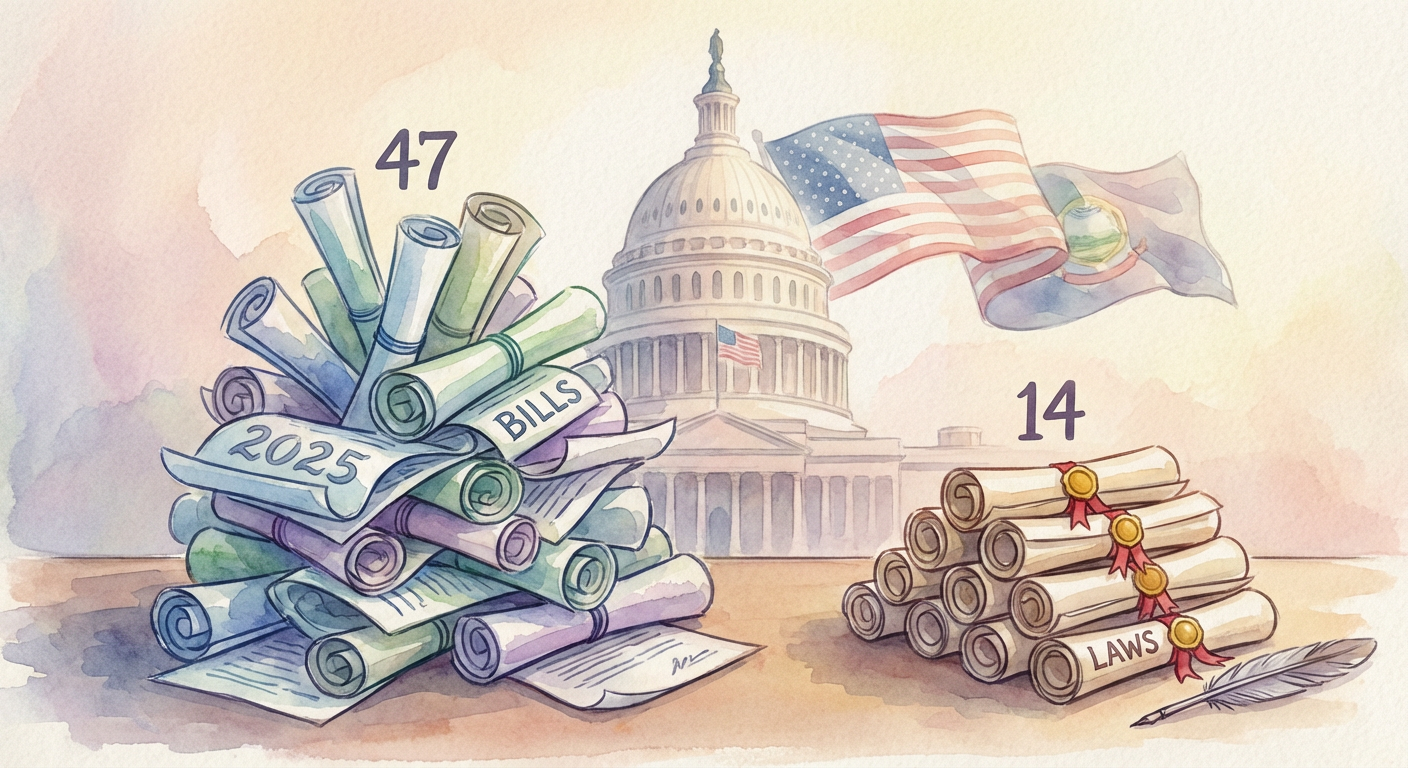
Executive orders grab headlines, but legislatures were the real engine of policy innovation in 2025. The National Conference of State Legislatures tracked 47 state-level bills introduced specifically to address state and local enforcement of federal immigration priorities. These bills ranged from restrictions on cooperation to affirmative duties to assist federal authorities. The diversity of approaches is worth noting. Some states moved toward stricter sanctuary protections. Others moved in the opposite direction. Fourteen of these bills were signed into law.
You can track this legislative work yourself through the National Conference of State Legislatures: Immigration Policy Database, which maintains detailed information about state-level immigration policy. What struck many observers was how granular these bills became. They specified which facilities ICE could access. They defined when officers could request cooperation. They created liability protections for some actors and not others. This is legislating at its most specific, which usually means the political battle is intense and the stakes feel real to constituents.
The Evidence on Public Safety: What the Research Actually Shows
One of the most durable claims in this debate is that sanctuary policies endanger public safety by shielding dangerous individuals from federal authorities. In September 2025, the Stanford Immigration Policy Lab Research team completed a comprehensive study examining violent crime rates in counties with sanctuary policies compared to counties without them. Their finding: no statistically significant difference. Counties with sanctuary policies did not experience higher violent crime rates than non-sanctuary counties.
This doesn’t mean the debate is settled. Research never settles political debates entirely. But it does mean that one of the central empirical claims underlying the debate now has strong evidence against it. Both sides in this argument deserve to reckon with that finding. If sanctuary policies don’t increase violent crime, then the policy case for opposing them rests on different grounds, maybe efficiency arguments or federalism principles or immigration law priorities. Those are legitimate arguments. But they’re different arguments, and they deserve clearer articulation now that the public safety claim has been tested against evidence.
What This Moment Teaches Us About American Federalism
The events of 2025 are a reminder that the federal system isn’t a clean hierarchy. It’s a network of overlapping authorities where governors can actually constrain federal action, courts can block executive directives, and legislators from both parties can force reckonings with evidence. None of these actors has total power. All of them have some leverage.
Understanding how your state responded matters. It matters not because one side is obviously right, but because you live in a state that actually has choices about how it engages with federal policy. That might sound obvious, but it’s worth saying plainly: your state government isn’t powerless. Its choices create real effects. If you want to understand what’s actually happening in your community, look at what your governor issued, what your legislature debated, what courts in your district ruled on. That’s where the civic action is real and your voice can matter.