

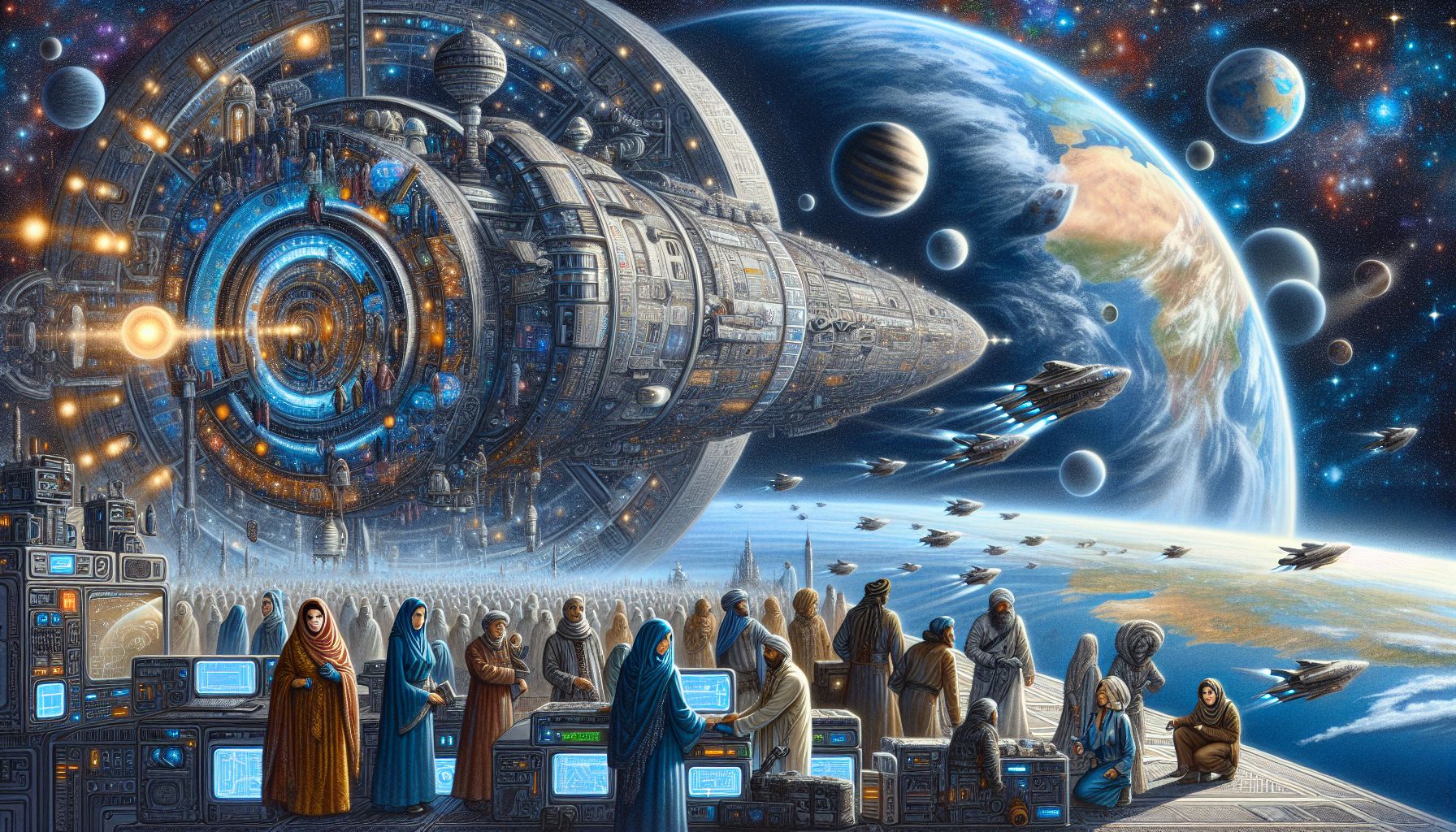
Ah, space travel—the ultimate frontier that has ignited humanity’s imagination since time immemorial (or at least since Jules Verne penned “From the Earth to the Moon”). I mean, who hasn’t looked up at the night sky and wondered what’s out there? But what’s really exciting is that we’re now living through a new age of space exploration, powered by technological breakthroughs that make our Star Trek dreams a little less fiction and a lot more fact. Let’s geek out about this, shall we?
Blast from the Past: A Brief Look Back
Before we jump into the nuts and bolts of futuristic space travel, let’s take a little detour down memory lane. Back in the 1960s, the space race was all about the US and the Soviet Union, and let’s be honest, those were serious glory days for space nerds. First, we had the Russians’ success with Sputnik and Yuri Gagarin’s historic first human orbit, followed by the Apollo missions that had the world huddled around black-and-white TVs.
But did you know those iconic missions were managed with computer power that’s basically equivalent to today’s pocket calculators? Mind-blown, right? Fast-forward to today’s world packed with quantum computers, AI, and more. Several tech whiz companies are picking up the space baton, ready to make science fiction our lived reality.
Enter the New Titans: Tech Companies Ventures
Okay, here’s where things get exciting. I’m talking about the big guns, yup, the likes of SpaceX, Blue Origin, and Virgin Galactic. Each is carving its own pathway to the stars like a cosmic Christopher Columbus.
SpaceX: From Falcons to Dragons
Elon Musk and his team over at SpaceX have been shaking things up faster than you can say “Falcon 9”. Their crowning glory? The ability to launch reusable rockets. Yep, those suckers fly back to Earth and land like something straight out of a Marvel movie, dramatically cutting costs. And then there’s Crew Dragon, the spaceliner that’s taken astronauts, and even some tourists, up to the ISS. I mean, space vacation? Yes, please!
Blue Origin: Slow and Steady
On the other side of the track is Jeff Bezos’s Blue Origin. These folks are playing the long game, with a focus on sustainable living in space. A noble cause! While SpaceX is practically running sprints, Blue Origin has the marathon approach, quietly doing the groundwork for a future where your Amazon Prime delivery might just have to sidestep a lunar rover.
Virgin Galactic: Space for All
Let’s not forget Richard Branson’s Virgin Galactic, which is practically synonymous with “space tourism,” a title it holds proudly. With suborbital flights taking customers to the edge of space, they’re democratizing the whole out-of-this-world experience. If your life savings don’t mind being exchanged for a quick jaunt in zero gravity, you’re in.
Perks and Perils: What Could Possibly Go Wrong?
So, what’s the endgame here? Beyond bragging rights, there are some serious perks and a few eyebrow-raising perils too.
The Upside of Upscale Space Ventures
First off, let’s talk about the incredible tech development. From advanced propulsion to life-support systems that are more efficient than your average office water cooler, this tech is paving the path for integrated system improvements on Earth. Environmental tech designed for space could help us make Earth a cleaner and sustainable haven. And then there’s the off-the-charts potential for scientific discoveries. Imagine life on other planets and mining asteroids for resources. It’s the golden age for scientists and entrepreneurs alike.
The Challenges: Come What May
Now, brace yourself for the rollercoaster of challenges. Launch failures are still very much a thing, and even a tiny miscalculation can cascade into a catastrophe. Money is another question. Not everyone has a billionaire buddy to shell out for their space dreams, and the cost barrier to entry is still high.
Lastly, let’s not overlook the ethical considerations. Colonizing Mars sounds great until you start thinking about the impact on any potential Martian amoebas we might displace. We might need a ‘first do no harm’ policy for space. What gives me comfort is knowing that new regulations are being put in place, prompting serious conversations about safety and ethics among the truly brilliant minds steering this ship.
Gaze into the Crystal Ball: Behold, the Futuristic Outlook
So, what’s the crystal ball saying about our space-driven tomorrows? If history’s anything to go by, we’re looking at a boom. Picture bustling lunar bases, a rise in international and corporate space collaborations, and maybe even “space traffic control” becoming a real job title. And you know, a few years down the line, commuting in space might become the next Uber. Imagine the app: “Launch vehicle? Yes, thanks. Destination: Outer Orbit Mall.”
Ultimately, it’s not just glittering stars and a vast void that drives these ambitions. It’s about possibility, the kind of possibilities that can transform life on Earth by exploring life beyond it.
Until then, let’s keep watching the skies, dreaming big, and applauding these pioneers. After all, the sky is no longer the limit, it’s just the beginning. 🚀